Can an AI-powered personal investment advisory bot operate in the U.S. — while meeting fiduciary standards?
Can AI Investment Advisers Meet Fiduciary Standards?
Yes - AI-powered investment advisers can operate under SEC fiduciary standards. They must provide advice in the client's sole interest, maintain full transparency about conflicts, and take complete responsibility for client relationships.
In my previous post, I discussed the growing gap: Younger clients increasingly demand tailored, trusted, fully-digital advice — yet most licensed Registered Investment Advisers (RIAs) continue to offer fragmented, traditional services. For more AI investment advisory resources, visit our Investment AI blog section.
Bridging this gap is likely to define the next generation of regulated AI-driven investment advisory.
The Twist: Demand Keeps Rising
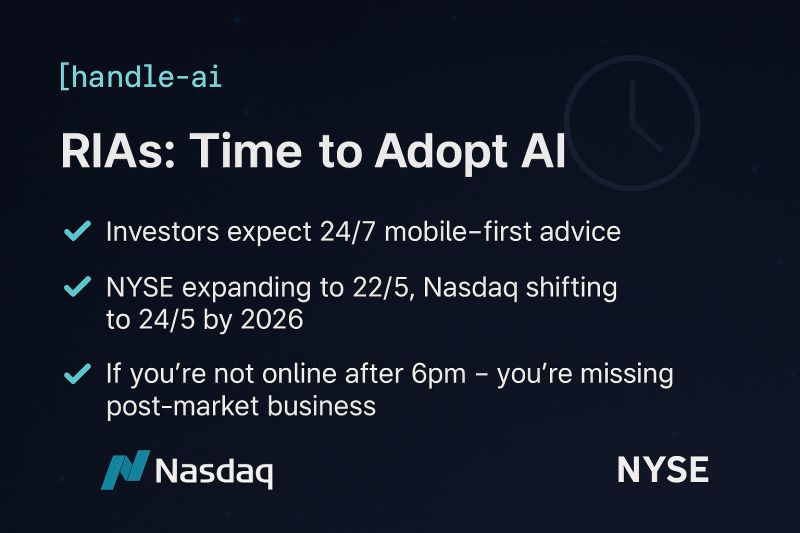
The major U.S. exchanges — NYSE and Nasdaq — driven by shifts in younger investor behavior, have already expanded or are preparing to expand trading hours toward near-continuous markets ⏱️ (at least five days a week).
As a result, financial intermediaries — including investment advisers — are being pushed to rethink their service models.
No longer just 9:30am to 4:00pm (the current core Nasdaq trading hours).
The SEC's Internet Adviser Exemption
Looking ahead, the U.S. Securities and Exchange Commission (as the federal regulator overseeing investment advisers) introduced in 2024 a dedicated regulatory pathway for advisers operating fully online: The Internet Adviser Exemption.
Normally, federal registration is required for advisers managing over $100 million AUM. Federal registration allows nationwide advisory services, subject to state-level representative licensing.
Under the Internet Adviser Exemption, the SEC permits federal registration even when AUM is below $100 million — provided the advisory services are offered exclusively via an active interactive website, with no non-digital (in-person or phone-based) client contact.
The key advantage: the ability to offer advisory services nationwide across the U.S.
From Robo-Advisers to AI Models
Originally designed to enable email-based advice and later accommodate robo-advisers (which typically relied on deterministic models), the exemption was updated in 2024 to also account for the rise of AI-powered models.
⚠ That said — as discussed in my prior post — this exemption does not fully address the regulatory challenges of delivering AI-powered fiduciary advice. It remains primarily suitable for early-stage ventures seeking broad national coverage.
Current Market Reality
In 2023, 239 advisers filed Form ADV under the Internet Adviser Exemption. These firms remain small: collectively managing $20.2 billion (a marginal amount — see prior post), and 113 of them reported no assets under management at all.
How RIAs Can Implement AI: 4 Steps
undefined
References
- CNBC: New York Stock Exchange to extend after-hours trading - https://www.cnbc.com/2024/10/25/new-york-stock-exchange-to-extend-after-hours-trading.html
- SEC Press Release 2024-42: Internet Adviser Exemption Updates - https://www.sec.gov/newsroom/press-releases/2024-42
- Investment Adviser Association: 2025 Snapshot Report - https://www.investmentadviser.org/wp-content/uploads/2025/05/Snapshot2025.pdf
- Nasdaq: 24x5 Market Data Solutions - https://www.nasdaq.com/solutions/market-data-apac/24x5
- Previous post: Will we soon see AI-powered investment advisers in the US? - https://handle-ai.com/knowledge/blog/investment-ai/will-we-soon-see-ai-powered-investment-advisers-us